
Choose an Engineering Data Management Approach
Choose an engineering data management approach by defining revision, access, approval, retrieval and recovery requirements first. Then test how each candidate workflow meets them and identify who operates every required control.
Teams comparing a shared-folder process, native cloud services or a managed PDM workflow.
Native cloud services and hosted classic PDM are different architectures.
Define the engineering data management decision
“Cloud or on-premise?” combines several different questions. Where data is stored is one question. How approval works, what the recipient can access, and who proves recovery are others. Begin with the operating problem so the hosting label does not become a substitute for requirements.
Write down a representative transaction: an engineer changes a design, a reviewer approves it, and manufacturing receives the released output. Add the locations and roles involved. This gives every candidate approach the same task to support.
Include your current process as a candidate. A small team with a simple, controlled handoff may need a clearer procedure before it needs a different platform. Conversely, repeated uncertainty about ownership or released information can justify evaluating stronger controls. The evidence should determine the scope.
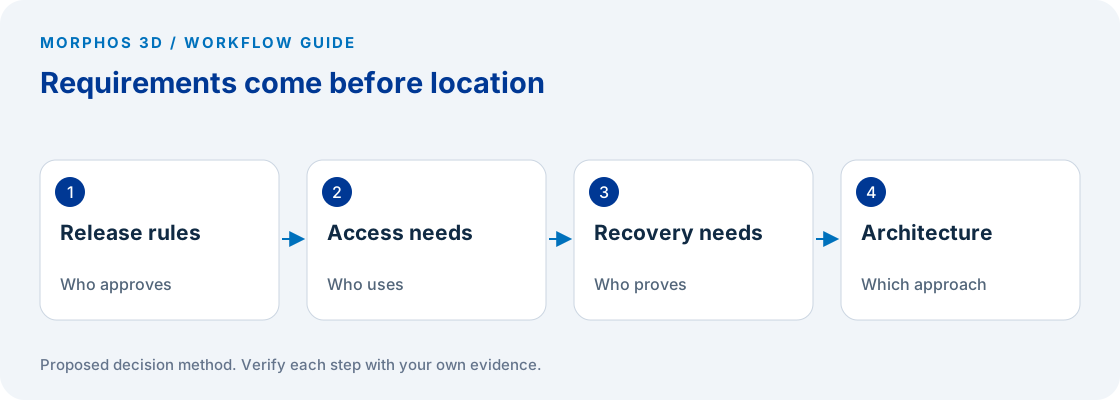
Compare controls rather than feature names
For each requirement, ask what action prevents or detects the failure. “Revision management” is too broad until the team defines how working changes differ from approved information and how recipients identify the intended output.
SOLIDWORKS PDM describes file checkout and search capabilities. Official PDM overview. The Store & Revise learning module describes collaborative spaces and cloud revision workflows. These are separate documented approaches; the descriptions do not establish identical capabilities, configuration, licensing or operating responsibilities. SOLIDWORKS Store & Revise learning module.
Test the exact candidate offering with the representative transaction. Record what is native, what requires configuration, what relies on a person, and what has not been demonstrated. A workflow can be viable with manual controls if the owners accept them and the process reliably fits the workload.
Assign operating responsibility before deployment
Identify who creates access, removes access, administers approvals, answers user questions and verifies recovery. For each responsibility, record whether it belongs to your team, a provider or another contracted party, then ask for the evidence that confirms the arrangement.
A hosted application and a native cloud service can distribute these responsibilities differently. Do not assume that moving server infrastructure changes the approval model or removes the need to manage users and content. Likewise, do not assume an on-premise deployment automatically satisfies a security or access requirement.
Have IT review the actual architecture and contractual terms. This article provides a requirements method, not a security assessment or a statement about where a particular customer's data will reside. Keep those decisions attached to verified documentation for the proposed configuration.
Put the method to work
Bring one release workflow and the operating responsibility that is currently unclear.
Use the worksheet belowTest the exception paths
Test a reviewer who needs access but should not edit the design. Test a departing user, an unavailable approver and a recipient outside the engineering department. These cases expose responsibilities that a normal designer-to-designer demonstration can miss.
Ask how the team handles a later design change after an output has been distributed. Verify the route by which recipients discover that earlier information is superseded. The existence of a current model in a managed location does not by itself establish that every external copy has been replaced.
Discuss recovery as a specific operating requirement. State the data and business process that must be recoverable, the acceptable interruption determined by the business, and the party responsible for proving the approach. Request evidence rather than treating a storage or synchronization label as the answer.
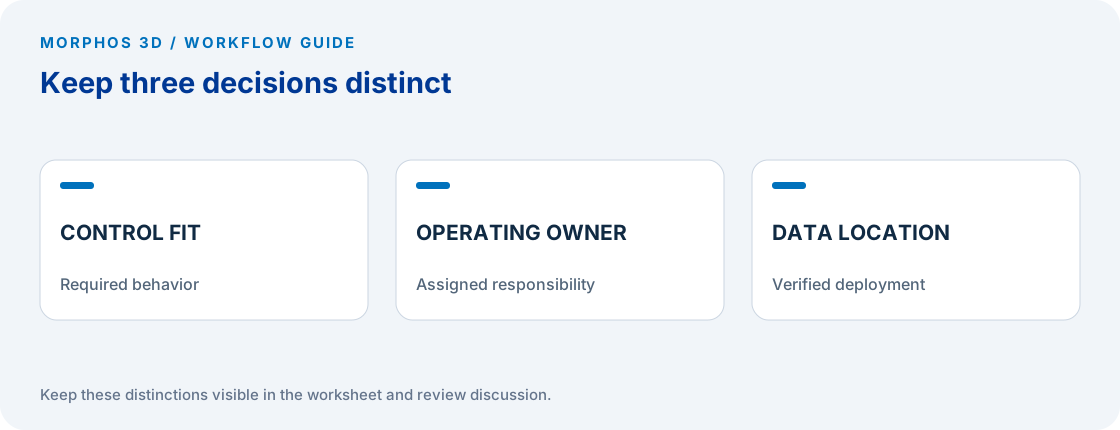
Select a pilot around the most important gap
Choose the smallest pilot that exercises the requirement your current process cannot satisfy reliably. If approval traceability is the concern, follow a change from working design to accepted output. If remote access is the concern, include the intended remote role and connection conditions.
Record success conditions before the pilot and include the effort needed to operate it. A process that works only while an expert manually repairs each handoff has different implications from one that the normal owners can maintain.
Keep architecture, control fit and operating effort as separate findings. Once the workflow is proven, the team can compare commercial proposals and deployment choices without losing sight of the original problem. The resulting recommendation should name the scope and the responsibilities it assumes.
Checks to carry into the discussion
| Requirement | Test to request | Responsible role to identify |
|---|---|---|
| Approved revision | Recipient identifies authorized output | Release owner |
| Concurrent work | Two intended users follow the edit process | Engineering system owner |
| External review | Restricted reviewer returns a comment | Access owner |
| Change distribution | Superseded package is handled correctly | Distribution owner |
| Recovery | Evidence covers required data and process | Recovery owner |
| Ongoing operation | Routine support and administration are assigned | Service owner |
Download the working worksheet
Create one row per requirement and candidate, using the same transaction across all approaches. Avoid treating a product name as evidence that the requirement is satisfied. Record the exact offering and configuration in the evidence reference. Have the operating owner review every manual responsibility. Select a pilot from the highest-consequence unresolved condition, then request the technical and commercial detail needed for that particular scope.
Fields: Requirement · Current process evidence · Candidate approach · Proposed control · Native/configured/manual/untested · Operating owner · Evidence reference · Exception tested · Open dependency · Acceptance result.
The worksheet and decision method are original Morphos 3D guidance. Fill them with your own evidence; the file contains no customer data or assumed results.
Bring one release workflow and the operating responsibility that is currently unclear.
Native cloud services and hosted classic PDM are different architectures.
Frequently asked questions
Is cloud-hosted PDM the same as a native cloud service?
No. Treat them as different architectures and verify the exact workflows, administration, access and contractual responsibilities of each proposed offering.
Should every team replace shared folders?
No. Evaluate the current process against explicit control and workload requirements. A documented process improvement may be sufficient for a limited scope.
Official references and method
References reviewed October 5, 2026. Product references support the specific capabilities discussed; the worksheets and decision steps are proposed guidance, not vendor benchmarks.
Discuss the next test
Bring one release workflow and the operating responsibility that is currently unclear.