
Most machine shops do not have an ERP problem. They have a spreadsheet problem. Jobs scheduled on a whiteboard, due dates tracked in someone's head, machine time guessed at, and quality records living in a binder. It works, until it doesn't: a hot job slips, a customer asks where their order is and nobody can say, and one machine sits idle while another is buried. DELMIAWorks ERP is built for exactly that gap. It is a manufacturing ERP and MES on one database, made for shops that run machines. Here is a practical look at what it is, what its modules do, and whether it fits your floor.
What DELMIAWorks is
DELMIAWorks, formerly IQMS, is a manufacturing ERP and MES from Dassault Systèmes built for discrete and process manufacturers. Unlike generic business ERP, it runs ERP, scheduling, real-time shop-floor monitoring, and quality on a single database, so the office and the floor work from the same live data instead of disconnected systems that never quite agree.
Signs your shop has outgrown spreadsheets
You do not need an ERP because a salesperson said so. You need one when the cracks start costing money. The usual signs:
- Someone keeps a side spreadsheet to track jobs, due dates, or material because your accounting software cannot.
- You cannot get a true job cost that combines material, labor, and actual machine time.
- Scheduling lives on a whiteboard or in one person's head, and a single sick day throws it off.
- A customer asks where their order is, and finding out means a walk to the floor and a few phone calls.
- You have no real material planning, multi-level BOMs, or routing through work centers.
- Quality records and traceability live in binders you would not want to hand an auditor.
QuickBooks and a stack of spreadsheets can run a small shop for a long time. When the workarounds start to outnumber the work, that is the signal.
ERP and MES, and why DELMIAWorks is both
Two acronyms are worth getting straight, because the combination is the whole point. ERP runs the business side: quotes, sales orders, material planning, inventory, costing, and accounting. MES runs the floor: what is actually running right now, which machines are up, how many parts came off, and why a job stopped. Most shops have some ERP, often QuickBooks plus spreadsheets, and little or no MES. The two never talk, so the office plans with numbers the floor cannot confirm.
DELMIAWorks puts both on one system. Production data from the floor flows straight into scheduling, costing, and inventory without re-keying. When a job runs long or a machine goes down, the schedule and the job cost reflect it automatically. That single connection is what shops feel the most once it is in.
The modules that matter to a machine shop
DELMIAWorks is broad. You do not turn everything on day one. These are the pieces a machine shop tends to lean on:
Estimating & Quoting
Build quotes from real material, cycle time, and labor data, then turn a won quote straight into a job without re-entering it.
MRP & Inventory / WMS
Plan material against demand, track stock and lots, and run a real warehouse with location control instead of a clipboard.
Scheduling & Production Planning
Finite, drag-and-drop scheduling that updates from live shop events so you can see the impact of a hot job before you commit to it.
RealTime Monitoring (MES)
Production, process, and machine monitoring that captures cycle counts, downtime reasons, and yields directly from your machines.
Quality (QMS)
SPC and data collection, CAPA, audit trails, and electronic signatures, with built-in support for ISO, FDA, ITAR, and AS9100 requirements.
Costing, Maintenance & More
Job and process costing, preventive maintenance, tooling, EDI, CRM, and business intelligence, all on the same database.
Real-time machine monitoring is the part shops feel first
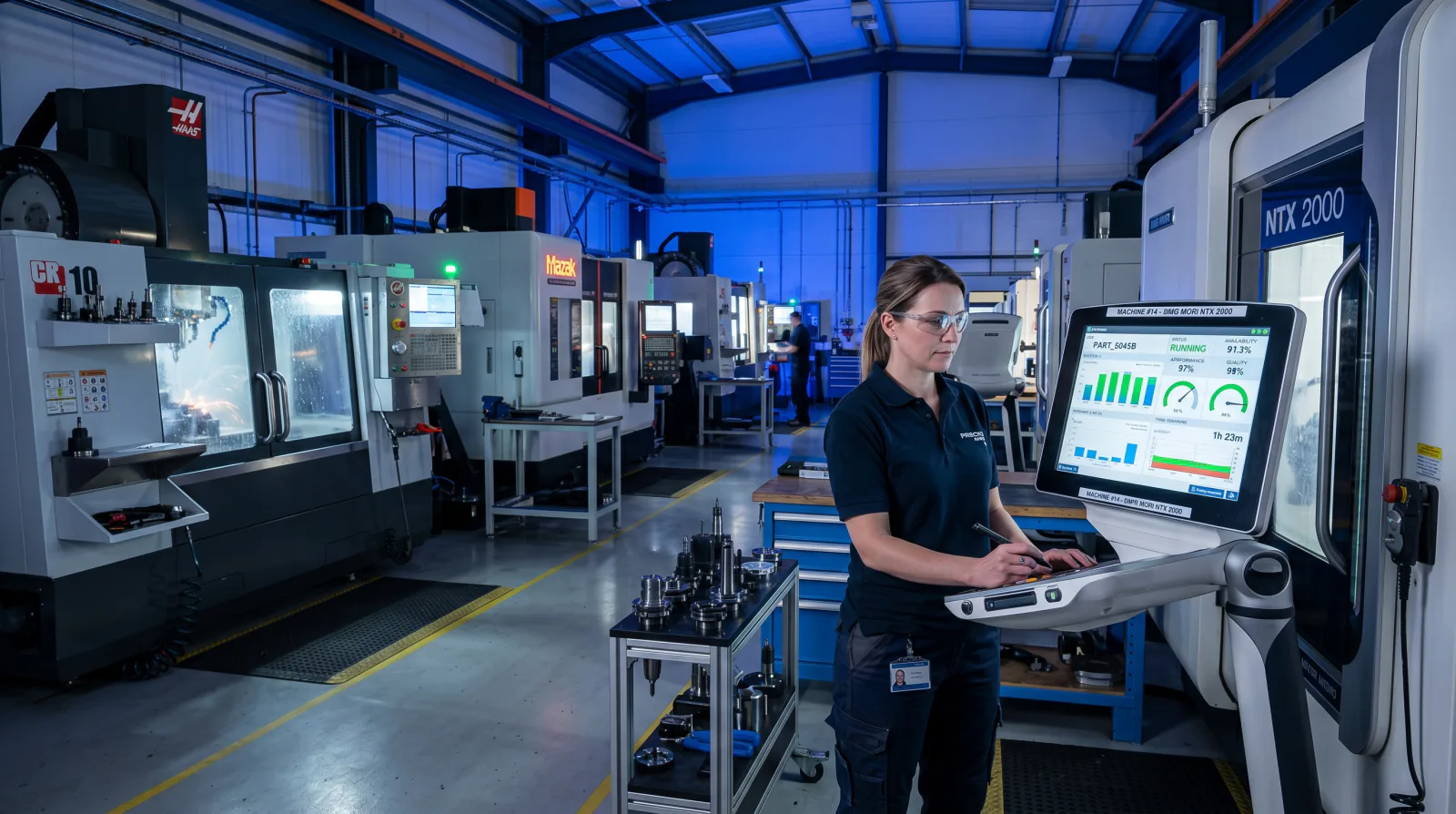
Ask a shop owner what their true machine utilization is and most will guess high. RealTime monitoring stops the guessing. It connects to your machines and captures cycle counts, downtime, and yields as they happen, then turns that into utilization and OEE you can actually act on. You stop scheduling against fiction and start scheduling against what your machines really do. Downtime gets a reason code instead of a shrug, and the reasons add up into a list you can fix.
Scheduling that updates itself
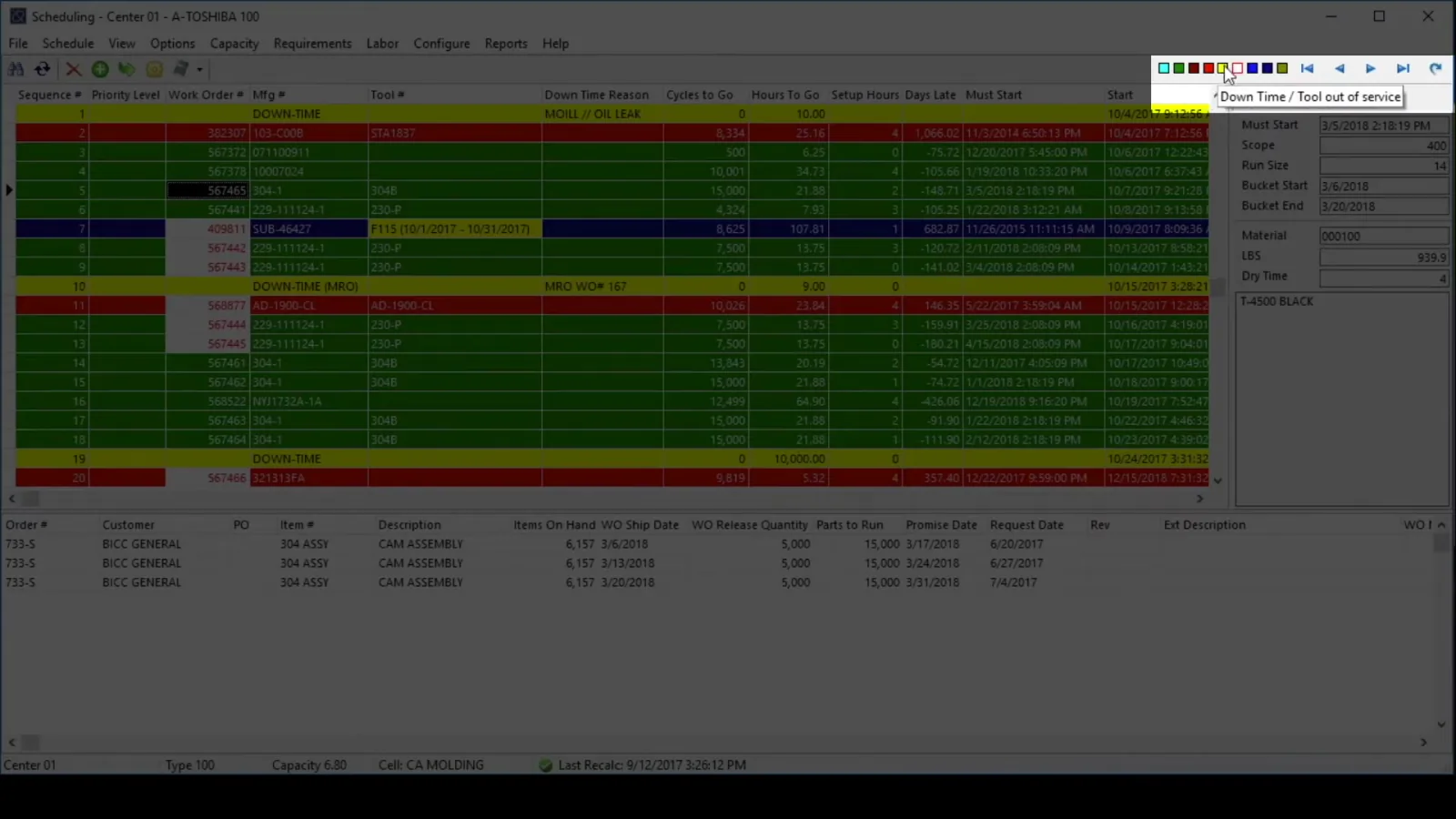
A static schedule is wrong the moment a job runs long. DELMIAWorks scheduling is finite, meaning it respects real capacity instead of assuming infinite machines, and it updates from events on the floor and across the supply chain. Drag a hot job in and you see what it pushes before you promise a date you cannot hit. For a shop juggling rush orders against a full board, that is the difference between a confident answer and a hopeful one.
Quality and traceability without the binder
If you are chasing or holding ISO 9001 or AS9100, quality cannot live in a filing cabinet. The DELMIAWorks quality suite covers SPC and data collection, CAPA, audit trails, and electronic signatures, with built-in support for ISO, FDA, ITAR, and AS9100. Track and trace ties lots and serials through the job, so when a customer asks what material went into a part shipped eight months ago, you have an answer in minutes, not days. Quality lives in the same system as the job, not beside it.
One database is the whole point
The deepest difference between DELMIAWorks and a stack of separate tools is architecture. It is a single integrated database. ERP, MES, scheduling, and quality are not bolted together with connectors that break on the next update; they are one system. That means fewer third-party integrations to maintain, no silos where the office number and the floor number disagree, and a single source of truth for the whole operation. For a shop already buying SOLIDWORKS, it also completes a clean line: design in SOLIDWORKS, program with SOLIDWORKS CAM, and run the job in DELMIAWorks, all of it answerable to the same data.
Wondering which modules your shop would actually use? Walk through it with an ERP specialist who knows manufacturing.
Get a QuoteHow it compares to job-shop ERPs like JobBOSS and E2
If you have shopped around, you have seen lighter job-shop systems like JobBOSS2, the former E2 Shop System, and cloud platforms like Plex. They are good tools, and for a small make-to-order shop they can be the right starting point. The difference is scope. DELMIAWorks bundles ERP and MES, including real machine monitoring, on one database built for manufacturing, where lighter systems often add monitoring as an extra or leave it out. Broader business platforms like NetSuite and SAP show up in the same searches, but those are general ERPs you adapt to manufacturing, where DELMIAWorks is manufacturing-first with MES already built in. That depth is also why DELMIAWorks is a bigger commitment to put in. The honest way to choose is by where your shop is headed, not only where it is today.
Is DELMIAWorks right for your shop?
It is not the lightest or cheapest option, and it should not pretend to be. DELMIAWorks fits best when:
- You have outgrown spreadsheets and a basic accounting package, and the seams are starting to cost you jobs.
- You want MES and machine monitoring without standing up a separate system to bolt on.
- You need real traceability and quality records for ISO, AS9100, or customer audits.
- You are ready to run your operation on one system, not just add another seat of software.
If you only need to model parts and cut a few programs, this is more than you need. If you are trying to run a whole shop and the office and the floor keep disagreeing, this is the kind of system that fixes the root cause.
How Morphos helps
An ERP is an implementation, not a download, and that is where most projects succeed or fail. We help you scope and implement DELMIAWorks around how your shop actually runs: which modules to turn on first, how to connect your machines for monitoring, and how to roll it out without stalling production. Because Morphos is rooted in CNC manufacturing through our connection to NextGen, we have lived the shop-floor side of this, not just the software. After go-live, our support team stays engaged so the system keeps earning its keep.