
Choose QMS architecture by the quality-event chain
A quality management system is the documented framework of processes, procedures, responsibilities, and records used to meet quality objectives. QMS software supports that framework. Integrated manufacturing QMS can keep inspection, nonconformance, inventory status, production, genealogy, documents, and cost in one transaction model. Standalone QMS can provide broader enterprise or specialist workflow depth. The right choice depends on object authority, process scope, validation, interfaces, and ownership.
| Decision factor | Integrated manufacturing QMS | Standalone QMS | Evidence to request |
|---|---|---|---|
| Production context | Can share order, item, lot, operation, and resource | Requires controlled exchange | Trace one defect to the exact work |
| Workflow depth | Verify native quality functions | May provide specialist enterprise workflows | Run the complete nonconformance and CAPA path |
| Inventory control | Can connect disposition to stock status | Interface must block or release material | Test hold, release, scrap, and rework |
| Documents and change | Can link manufacturing and quality records | May govern documents across systems | Test revision, training, effectivity, and acknowledgement |
| Ownership | Potentially fewer system boundaries | Requires cross-system reconciliation | Name business and technical owners |
Map the event before comparing feature lists
Begin with a credible failure: incoming material misses a characteristic, an in-process measurement trends out of control, an operator reports a defect, or a customer return identifies a field issue. Record detection, containment, identification, risk, disposition, correction, verification, closure, and every affected object.
The event may need to change inventory status, stop or condition production, notify planning, create rework, update a supplier record, revise a document, preserve genealogy, and capture cost. If the QMS records the investigation but cannot reliably control those downstream states, the integration becomes part of the quality process and needs validation and ownership.
- Identify the item, revision, lot or serial, supplier, order, operation, resource, person, and requirement.
- Separate immediate containment from final disposition and corrective action.
- Define who can place and release a hold and where that state is enforced.
- Link document and process changes to effectivity and required training.
- Preserve objective closure evidence and effectiveness review.
Use integrated quality when transaction context drives control
Integrated quality is attractive when inspections, nonconformances, traceability, inventory, production, and cost use the same controlled identities and statuses. It can reduce re-entry and make a quality disposition affect the manufacturing transaction directly. That value depends on process depth and permissions, not on the word integrated.
Test the complete workflow. Fail an incoming inspection, place a lot on hold, attempt to issue it to production, create a disposition, generate rework, update cost, and release the remainder. Confirm role separation, audit history, notifications, signatures where required, reports, and the relationship to the original item, order, supplier, and inspection result.
Software does not create certification or compliance
Certification and regulatory conformity depend on the organization, scope, controlled processes, evidence, competence, audits, and applicable requirements. Product functions can support those controls but do not create the result by themselves.
Use standalone QMS when enterprise or specialist depth governs the decision
A standalone QMS can be appropriate when quality governance spans many ERP instances, nonmanufacturing processes, regulated document and training controls, supplier networks, laboratories, product lifecycle records, or specialist risk and validation needs. The tradeoff is the need to govern shared objects and enforce quality states across system boundaries.
List every object and event that must cross the boundary. Define item and revision identities, supplier and customer references, lot and serial genealogy, inspection results, holds, dispositions, change records, training status, and cost. Test delayed and rejected messages, duplicate events, correction, version change, outage, replay, and daily reconciliation.
| Pattern | Strong fit signal | Risk to test |
|---|---|---|
| Integrated | Quality control is tightly coupled to ERP and production objects | Workflow depth or enterprise scope may be insufficient |
| Standalone | Quality governance spans systems or needs specialist depth | Holds, revisions, and dispositions may not control manufacturing in time |
| Hybrid | Different layers have clear ownership | Duplicate records and unclear closure authority |
Verify DELMIAWorks quality functions with the real process
Dassault Systèmes public DELMIAWorks material documents quality functions including inspections, SPC, audits, document control, engineering change, gage analysis, and traceability. Some source documents are older public data sheets, so current availability, configuration, validation support, and commercial packaging need confirmation.
Use the same event chain and decision matrix for DELMIAWorks and any alternative. Demonstrate the required quality object, its effect on material and work, its downstream records, correction, reporting, security, and recovery. Keep certification and outcome claims outside the evaluation unless supported by the organization's own evidence.
Compare QMS options with one controlled event chain
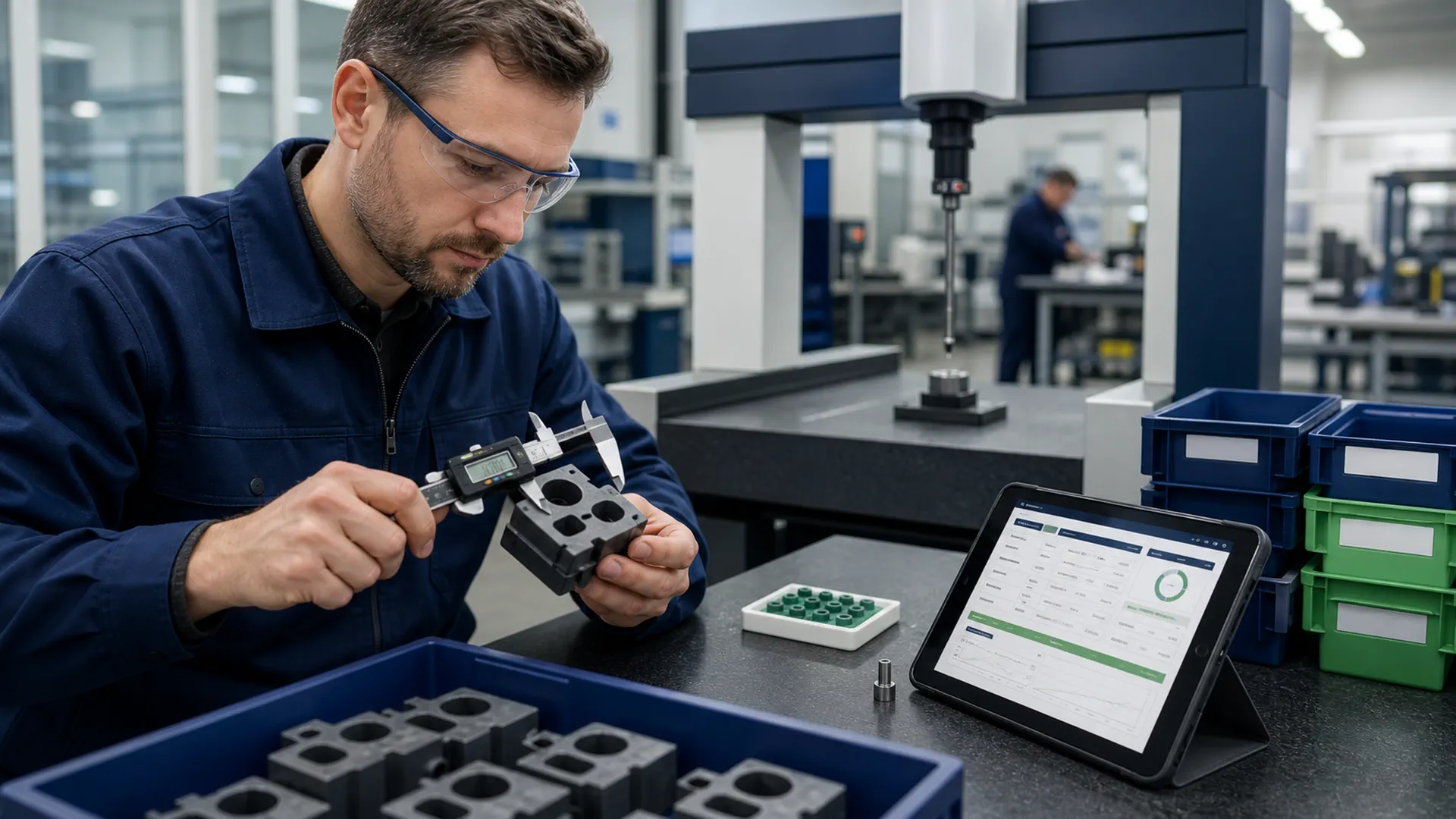
The decision matrix records quality objects, integrated and standalone evidence, required interfaces, owners, tests, and the selected pattern.
Frequently asked questions
What is a QMS in manufacturing?
A manufacturing QMS is the documented framework of processes, procedures, responsibilities, controls, and records used to meet quality objectives across supplied material, production, products, and improvement.
Is QMS software the same as a QMS?
No. Software can support controlled documents, inspections, nonconformance, corrective action, audits, training, SPC, traceability, and records. The organization's governed processes and responsibilities form the QMS.
When does an integrated QMS make sense?
It is a strong candidate when quality events must directly control shared manufacturing objects such as items, lots, orders, operations, inventory status, genealogy, documents, and cost.
When does a standalone QMS make sense?
It can fit when enterprise quality spans several business systems or needs specialist workflow, document, training, risk, laboratory, supplier, or validation depth. The required ERP and production controls still need governed interfaces.
References and method
- ASQ: Quality management system, QMS definition and framework
- DELMIAWorks QMS data sheet, vendor-documented quality functions; current configuration requires verification
- Dassault Systèmes DELMIAWorks, current manufacturing ERP and MES architecture
- The tables, diagrams, selection questions, and downloadable register are Morphos 3D guidance. Verify product configuration, interfaces, validation requirements, and commercial packaging for the exact release and operating environment.
Trace one quality event across the manufacturing record
Use the matrix to test containment, disposition, inventory, production, documents, cost, correction, and closure before selecting an integrated or standalone pattern.